
Introduction
Descriptive essays are among the most creative and engaging forms of academic writing. They give writers an opportunity to use words to create vivid pictures, allowing readers to experience a person, place, object, event, or emotion through detailed language. A successful descriptive essay does more than simply provide information—it makes the reader feel as though they are part of the experience. Whether you are a high school student, college student, or simply looking to improve your writing skills, this guide will help you understand how to write a powerful descriptive essay. Need help improving your descriptive essay? EssayAssists can provide writing guidance, editing support, and personalized assistance to help you develop clearer, more engaging, and well-structured academic writing.
A descriptive essay is a type of writing that focuses on describing something in detail. The purpose is to help readers clearly imagine the subject being discussed. Descriptive essays are a type of academic writing in which students provide a detailed description of a specific subject, object, person, place, or experience. Their purpose is to assess a student’s ability to create a vivid and engaging written account that captures the essence of what is being described. This type of essay also gives students the freedom to use their creativity and imagination in their writing. A descriptive essay is successful when readers can easily visualize the subject and develop a clear impression of the experience being discussed. If the writing fails to create this mental picture, it may not effectively meet the characteristics of a descriptive essay.
You may be asked to describe: A memorable place, A person who has influenced your life, A special event, An object with personal meaning, A childhood memory, A natural environment, An emotion or experience. The best descriptive essays appeal to the reader’s senses. Instead of simply telling readers what something was like, the writer shows them through carefully chosen details.
For example, instead of writing:
The beach was beautiful.
You could write:
Golden sand stretched beneath my feet as the warm ocean breeze carried the salty scent of the sea.
The second sentence creates a clearer and more memorable image.
Understanding the Power of the Five Senses
One of the most important techniques in descriptive writing is using sensory details. Think about what you can: See, Hear, Smell, Taste, Touch. Using these senses helps transform ordinary descriptions into vivid experiences. For instance, imagine describing a busy marketplace. Rather than saying it was crowded and noisy, you could describe the sounds of people negotiating prices, the aroma of freshly prepared food, the bright colors of products, and the feeling of moving through the crowd. However, you do not need to force all five senses into every paragraph. Use the details that naturally strengthen your description.
Step 1: Choose a Strong and Interesting Topic
The first step in writing a descriptive essay is selecting a topic you can describe clearly and passionately. A strong topic usually gives you plenty of specific details to explore. For example, instead of choosing a broad topic such as “My Vacation,” narrow it down to a specific moment:
“The Night I Got Lost in a New City.”
A focused topic makes your essay easier to organize and gives you more opportunities to provide meaningful details.
Step 2: Create a Clear Thesis Statement
Even though descriptive essays are creative, they still need a clear central idea. Your thesis statement should introduce the subject and communicate the main impression you want readers to have.
For example:
My grandmother’s kitchen was more than a place to prepare food; it was a place filled with warmth, memories, and the comforting feeling of home. This statement tells readers what will be described while also establishing the emotional tone of the essay.
Step 3: Write an Attention-Grabbing Introduction
Your introduction should immediately draw readers into the experience. Instead of beginning with a dictionary definition or a general statement, try using a vivid image, an interesting sound, or an emotional moment.
For example:
The first thing I noticed was the smell of rain. It drifted through the open window as dark clouds slowly covered the afternoon sky.
This opening encourages readers to continue because they immediately enter the scene.
A strong introduction should generally include: An engaging hook, Background information about the subject and A clear thesis statement
Step 4: Organize Your Essay Carefully
Need help improving your descriptive essay? EssayAssists can provide writing guidance, editing support, and personalized assistance to help you develop clearer, more engaging, and well-structured academic writing.
A descriptive essay should have a logical structure. A common format includes:
Introduction
Introduce the subject and establish the main impression.
Body Paragraph One
Describe the first major aspect of your topic.
Body Paragraph Two
Develop another important detail or experience.
Body Paragraph Three
Explore additional details and strengthen the overall impression.
Conclusion

Bring the experience together and explain why the subject is meaningful. You can organize your essay by: Physical appearance, Time sequence, Location, Importance and Emotional development The structure you choose should make the experience easy for readers to follow.
“Show, don’t tell” is one of the most valuable rules in descriptive writing.
Telling gives readers basic information:
I was nervous.
Showing allows readers to experience the emotion:
My hands trembled as I stared at the closed door, and my heart seemed to beat louder with every passing second.
The second example is more powerful because it demonstrates nervousness through physical reactions.
Whenever possible, ask yourself: Can I help the reader experience this instead of simply explaining it?
Step 6: Use Strong and Specific Language
Need help improving your descriptive essay? EssayAssists can provide writing guidance, editing support, and personalized assistance to help you develop clearer, more engaging, and well-structured academic writing. Weak words can make even an interesting topic feel boring. Choose specific nouns, powerful verbs, and meaningful adjectives.
For example, instead of writing:
The dog walked quickly.
You might write:
The energetic puppy raced across the field, chasing leaves that danced in the wind.
Specific language creates stronger images and makes your writing more enjoyable to read.
Step 7: Include Figurative Language
Figurative language can make your descriptions more creative and memorable. Some useful techniques include:
Similes
A comparison using “like” or “as.”
The lake shimmered like a sheet of glass beneath the morning sun.
Metaphors
A direct comparison between two things.
The city was a living machine that never seemed to sleep.
Personification
Giving human characteristics to non-human things.
The old trees whispered as the wind moved through their branches.
Use figurative language carefully. Too many comparisons can make an essay feel exaggerated or confusing. The goal is to improve the reader’s understanding of the scene.
Step 8: Create an Emotional Connection
The strongest descriptive essays often include more than physical details. They also explain why the experience, person, or place matters. For example, you might describe an old house not simply by discussing its appearance but by connecting it to memories of family, childhood, or personal growth. This emotional layer gives your writing depth. Readers are more likely to remember an essay when they understand the feelings connected to the experience.
Tips for Writing an Excellent Descriptive Essay
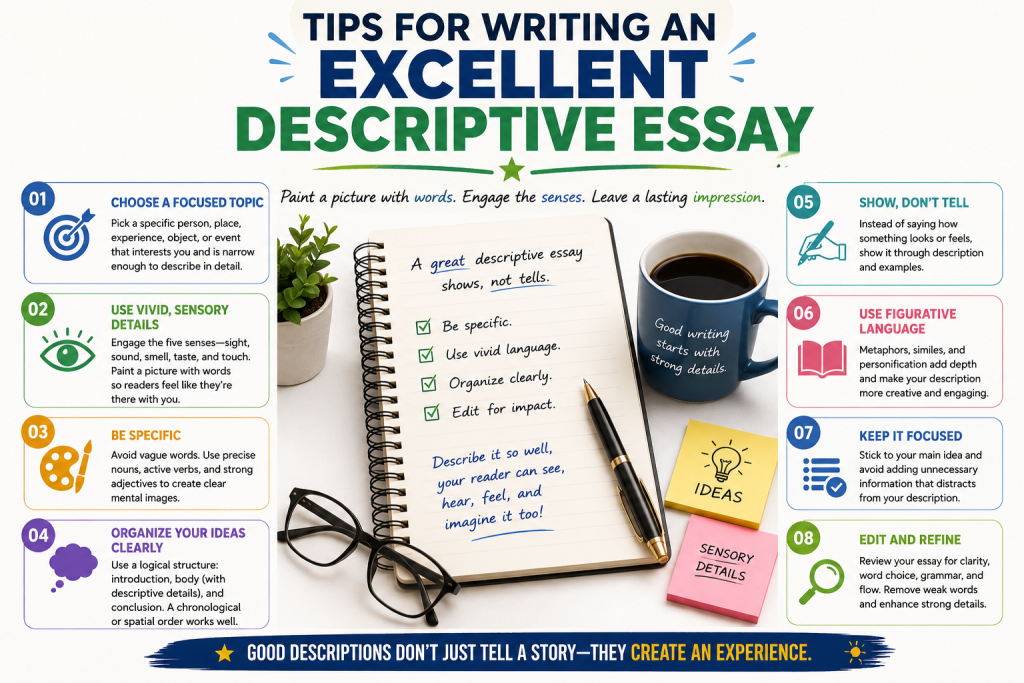
Need help improving your descriptive essay? EssayAssists can provide writing guidance, editing support, and personalized assistance to help you develop clearer, more engaging, and well-structured academic writing.
- Start with brainstorming – Brainstorming is an essential first step in descriptive writing. Before you begin, identify the main ideas and details you want to include. For example, if you are asked to describe a phone, you could list its size, color, design, screen, camera, and other noticeable features. These points will serve as a guide during the writing process and reduce the chances of leaving out important information.
- Prepare a draft and outline – Begin by creating an outline that organizes your ideas before developing the first draft. Your goal should be to present the subject in a way that allows readers to experience it clearly. Focus on showing rather than simply telling by using descriptive details and sensory language.
- Use clear and precise language – Your choice of words is extremely important in a descriptive essay. Since the purpose is to help readers understand and visualize your subject, use language that is straightforward, relevant, and easy to understand. Carefully selected words will communicate your intended meaning more effectively.
- Use vivid and specific vocabulary – Vivid language helps create strong images in the reader’s mind. Instead of using general words, choose more specific and expressive alternatives where appropriate. For instance, using the word stallion instead of simply horse immediately gives readers a more precise image of what is being described.
- Appeal to the five senses – Effective descriptive essays engage the reader’s senses of sight, sound, smell, taste, and touch. If you are describing food, for example, explain its appearance, aroma, texture, and flavor. Sensory details make your writing more realistic and allow readers to feel as though they are experiencing the subject themselves.
- Express emotions and feelings – Describing your emotions can add depth and meaning to your essay. Explain how the experience or subject made you feel and communicate those emotions convincingly. Emotional details can help readers connect with your writing on a deeper and more personal level.
- Leave a lasting impression – A successful descriptive essay should give readers a clear and memorable impression of the subject. Your description should be powerful enough to create a sense of familiarity or appreciation. For example, a well-written description of a delicious meal might leave readers imagining its taste—or even craving it.
- Organize your ideas logically – Organization is just as important as creativity. Arrange your descriptions in a clear and logical order so readers can easily follow your ideas. A well-structured essay improves readability and helps readers develop a complete understanding of the subject.
- Revise and improve your work – Once you have completed your first draft, take time to review it carefully. Ask yourself whether the essay makes sense, whether your descriptive and figurative language is effective, whether the details create a complete picture, and whether your writing establishes a meaningful connection with the reader.
- Share or publish your final work – After editing and proofreading your essay, you can submit or publish the final version. Sharing your work with classmates, teachers, or other readers can also provide valuable feedback and help you improve your writing skills.
.Common Mistakes to Avoid
When writing a descriptive essay, try to avoid these common mistakes:
Using Too Many Adjectives
Adding several adjectives does not always improve a sentence. Choose the most effective words instead.
Repeating the Same Words
Look for synonyms and different ways to express your ideas.
Forgetting the Main Focus
Every paragraph should contribute to the overall impression created by your thesis.
Providing Too Many Unnecessary Details
Not every detail is important. Focus on details that help readers understand or experience the subject.
Ignoring Editing and Proofreading
Creative writing still requires correct grammar, punctuation, spelling, and sentence structure.
A Simple Descriptive Essay Writing Formula
If you are unsure where to begin, follow this simple formula:
Before writing, take a few minutes to brainstorm. Write down everything you remember about the subject, including sights, sounds, smells, emotions, and important memories. You can then select the strongest details for your essay.
Final Tips for Writing an Outstanding Descriptive Essay
Before submitting your essay, ask yourself:
- Can readers clearly imagine what I am describing?
- Have I used specific sensory details?
- Do my paragraphs have a logical order?
- Have I shown emotions instead of simply naming them?
- Does my introduction capture attention?
- Does my conclusion leave a lasting impression?
- Have I checked my grammar and spelling?
If you can confidently answer “yes” to these questions, you are well on your way to producing an excellent descriptive essay.
Conclusion
Writing a descriptive essay is an opportunity to bring your ideas and experiences to life through words. The key is to observe carefully, select meaningful details, and create an experience that readers can see, hear, and feel. Descriptive essays can be challenging because they require creativity, careful observation, and strong writing skills. However, with proper planning, effective sensory details, vivid language, logical organization, and regular practice, anyone can learn to write a compelling and memorable descriptive essay. Remember that great descriptive writing is not about using the most complicated vocabulary. It is about choosing the right words to create a clear and powerful impression. With a strong topic, sensory details, effective organization, and careful editing, you can turn an ordinary subject into an unforgettable piece of writing.
Need help improving your descriptive essay? EssayAssists can provide writing guidance, editing support, and personalized assistance to help you develop clearer, more engaging, and well-structured academic writing.
Frequently Asked Questions About Descriptive Essays
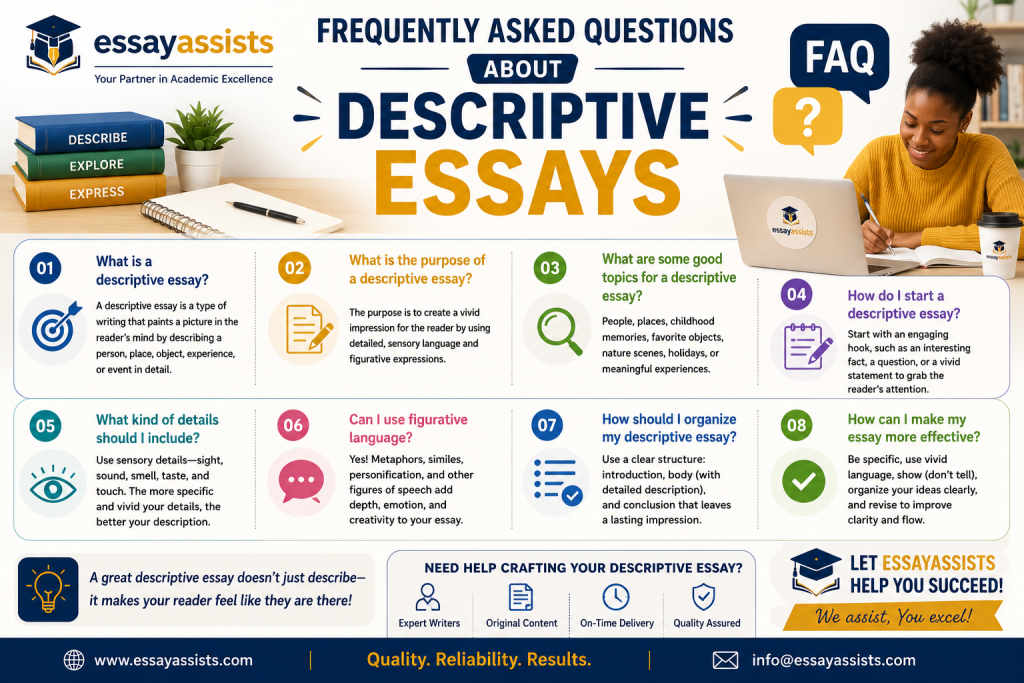
1. What is a descriptive essay?
A descriptive essay is a type of academic writing that uses detailed and vivid language to describe a person, place, object, event, or experience. Its purpose is to help readers form a clear mental picture of the subject.
2. What is the purpose of a descriptive essay?
The main purpose is to create an engaging experience for the reader. A well-written descriptive essay appeals to the senses and allows readers to imagine what the writer is describing.
3. How do I choose a good descriptive essay topic?
Choose a topic that you can describe in detail. Good topics may include a memorable experience, a favorite place, an influential person, a special object, or an important event.
4. How can I make my descriptive essay more interesting?
Use vivid vocabulary, sensory details, figurative language, and emotional descriptions. Instead of simply telling readers about something, show them through specific and engaging details.
5. What does “show, don’t tell” mean in descriptive writing?
“Show, don’t tell” means allowing readers to understand an experience through descriptive details rather than directly stating information.
For example, instead of writing, “I was nervous,” you could write, “My hands trembled as I waited for my name to be called.”
6. Should I use the five senses in a descriptive essay?
Yes. Using details related to sight, sound, smell, taste, and touch can make your writing more realistic and engaging. However, use only the sensory details that are relevant to your subject.
7. How should I structure a descriptive essay?
A descriptive essay typically includes an introduction, body paragraphs, and a conclusion. The introduction presents the subject, the body paragraphs provide detailed descriptions, and the conclusion leaves readers with a lasting impression.
8. Can I use figurative language in a descriptive essay?
Yes. Literary techniques such as similes, metaphors, and personification can make your descriptions more vivid and memorable when used appropriately.
9. How can EssayAssists help me with a descriptive essay?
EssayAssists can provide academic writing guidance to help students understand essay structure, improve descriptive techniques, organize their ideas, and strengthen grammar and clarity. The platform can also support students with editing and proofreading to help them improve their final drafts while maintaining their own ideas and voice.
10. Does EssayAssists offer help with editing and proofreading?
Yes. EssayAssists can help students improve the clarity, organization, grammar, and overall presentation of their descriptive essays. Getting feedback on a draft can help identify areas that need improvement before submission.
11. Why should I seek guidance from EssayAssists?
Writing a strong descriptive essay requires creativity, organization, and effective language. EssayAssists offers writing support and guidance designed to help students develop stronger academic writing skills and produce clearer, more engaging essays.
12. Can EssayAssists help with other types of essays?
Yes. In addition to descriptive essay guidance, EssayAssists can provide support for various academic writing tasks, including essays, research papers, reports, and other assignments.