Introduction
Writing an essay can feel challenging for many students, but for students with dyslexia, the process may require additional planning, time, and the right strategies. Difficulties with spelling, reading, organizing ideas, and proofreading can sometimes make essay writing frustrating. However, dyslexia does not mean that a student lacks intelligence, creativity, knowledge, or great ideas. With effective techniques, assistive technology, and proper support, students with dyslexia can produce clear, well-structured, and impressive essays. At EssayAssits, we believe every student deserves the opportunity to communicate their ideas with confidence.
Use a Mind Map
Starting an essay can be challenging for any student because it requires you to organize your thoughts and present your ideas in a clear, logical order. For students with dyslexia, this process may sometimes feel even more difficult. Creating a well-structured essay is essential for producing work that is clear, concise, and easy to follow. One effective way to organize your ideas is by using a mind map. A mind map provides a visual representation of your thoughts, making it easier to plan your essay before you begin writing.
Start by placing your main essay topic in the center of the diagram. Then, create branches for your key arguments, supporting points, examples, and other relevant ideas. You can add smaller branches to develop each major point further. This visual approach can help you see the relationship between different ideas and create a more organized structure for your essay. Before moving on to the writing stage, take time to consider the main arguments you want to discuss and how they will support your overall position.
Writing an Engaging Introduction
Once your mind map is complete, you can use it as a guide when drafting your essay. The introduction is particularly important because it gives readers their first impression of your work and introduces the subject you will discuss. Begin with an engaging opening that captures the reader’s attention. You might use an interesting fact, a thought-provoking question, a brief example, or another relevant approach depending on the type of essay you are writing.
Your introduction should clearly introduce the topic and provide an indication of the main points that will be discussed. It is also important to end the introduction with a clear thesis statement that presents the central argument or purpose of your essay.
Building Clear and Effective Paragraphs
After writing a strong introduction, you can begin developing the body of your essay. Each paragraph should focus on one main idea and explain it clearly for the reader. Use your mind map as a reference when developing your paragraphs. Take one of the main ideas from your diagram and expand it using explanations, examples, evidence, or supporting details.
A typical paragraph should include: A clear topic sentence, An explanation of the main idea, Supporting examples or evidence, Further discussion or analysis, A concluding or linking sentence where appropriate. Try to write in a clear and direct manner. Explain your ideas as though you are helping someone understand the topic for the first time. Avoid adding unnecessary information, and make sure every paragraph contributes to your overall argument.
Finish With a Strong Conclusion
The conclusion provides the final impression of your essay. It should bring your main ideas together and give the reader a clear understanding of your overall argument. A strong conclusion should briefly summarize the important points discussed throughout the essay without simply repeating entire sentences from the body. It should also reinforce your main argument and provide a meaningful final thought. By ending your essay clearly and confidently, you can create a stronger overall impression and demonstrate that your discussion has reached a logical conclusion.
Edit and Proofread Your Work Carefully
Editing and proofreading are essential parts of the writing process. Some students with dyslexia may experience challenges with spelling, word order, or other aspects of written language, making it especially important to review their work carefully. After completing your first draft, take a break before proofreading if possible. Then review your essay slowly and focus on different areas separately, including: Spelling, Grammar, Punctuation, Sentence clarity, Paragraph structure, Overall organization. You may also find it helpful to use assistive technology, such as spell-checking or text-to-speech tools, to review your work. Reading your essay aloud or listening to it can make certain mistakes easier to identify. If you need additional support, feedback from a qualified teacher, tutor, editor, or academic support professional can also help you improve your work.
In this 2026 guide, we share practical tips to make essay writing easier and more manageable.
1. Start by Understanding the Essay Question
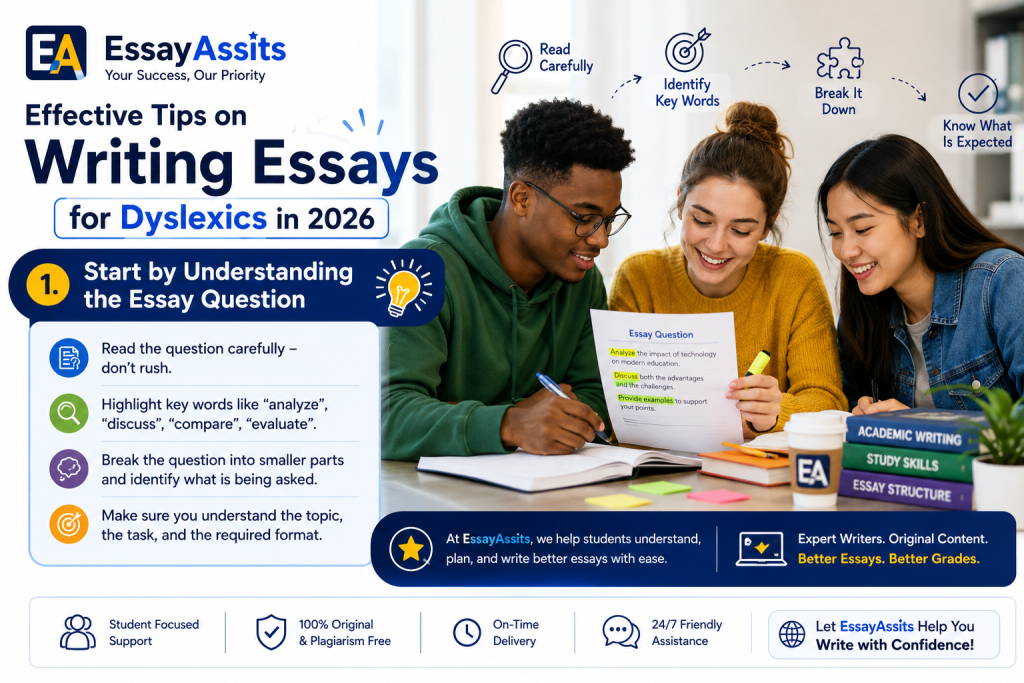
Before writing anything, carefully examine the assignment question. Dyslexic students may find it helpful to break a long question into smaller sections.
Ask yourself: What is the main topic? What am I being asked to explain or discuss?, Do I need to argue, compare, analyze, or describe?, How many words or pages are required?, What sources should I use?
Highlight important instruction words such as analyze, compare, discuss, or evaluate. If the question feels confusing, rewrite it in simpler language. Understanding the task before starting can prevent unnecessary mistakes later.
2. Break the Essay Into Small Steps
One of the most effective strategies is to avoid viewing the essay as one large task. Instead, divide it into manageable stages. A simple essay-writing process is: Understand the question, Research the topic, Brainstorm ideas, Create an outline, Write the first draft, Revise the content, Check grammar and spelling, Submit the final version. Breaking large assignments into smaller tasks can make writing feel less overwhelming. Students with dyslexia often benefit from planning their work and giving themselves sufficient time.
3. Use Mind Maps and Visual Planning
Many dyslexic students are highly visual and creative thinkers. A mind map can be an excellent way to organize ideas before writing. Place your main essay topic in the center and create branches for: Your main arguments, Supporting evidence, Examples, Research sources, Important keywords. After creating your mind map, turn each major idea into a paragraph. Visual planning tools can help students organize their thoughts before transferring them into sentences and longer pieces of writing.
4. Create a Simple Essay Outline
Once you have your ideas, organize them into a clear structure.
Introduction
Include:
- Background information
- The main topic
- Your thesis statement
Body Paragraph 1
Present your first main argument and supporting evidence.
Body Paragraph 2
Explain your second important point.
Body Paragraph 3
Present another argument, example, or analysis.
Conclusion
Summarize your main points and reinforce your overall argument.
An outline acts like a roadmap and helps prevent ideas from becoming disorganized during the writing process.
5. Use Speech-to-Text Technology
In 2026, technology continues to make academic writing more accessible. Speech-to-text tools allow students to speak their ideas instead of typing every word. This can be particularly useful when a student has strong verbal communication skills but finds spelling or typing difficult.
A helpful process is:
Think → Speak → Review → Edit
Speak naturally and focus first on communicating your ideas. Afterward, review the generated text and make corrections. Speech recognition and dictation tools can help some learners produce written work more efficiently, although the final text should always be reviewed carefully.
6. Type Instead of Writing by Hand
Handwriting can sometimes slow down the writing process. Typing allows students to focus more on their ideas and less on the physical process of writing. Word processors also make it easier to: Move paragraphs, Add missing information, Correct mistakes, Check spelling, Rearrange ideas, Save multiple drafts
Digital writing tools can reduce the burden of handwriting and make revision easier.
7. Don’t Worry About Perfection in the First Draft
Trying to write a perfect essay immediately can create unnecessary pressure.
Your first draft is simply the beginning.
Focus first on:
- Getting your ideas onto the page
- Explaining your arguments
- Including relevant evidence
Do not stop every few seconds to correct spelling or grammar. Editing can come later.
A useful approach is to separate the writing process into three stages:
This allows you to concentrate on one task at a time instead of trying to manage ideas, spelling, grammar, and structure simultaneously.
8. Use Assistive Technology Wisely
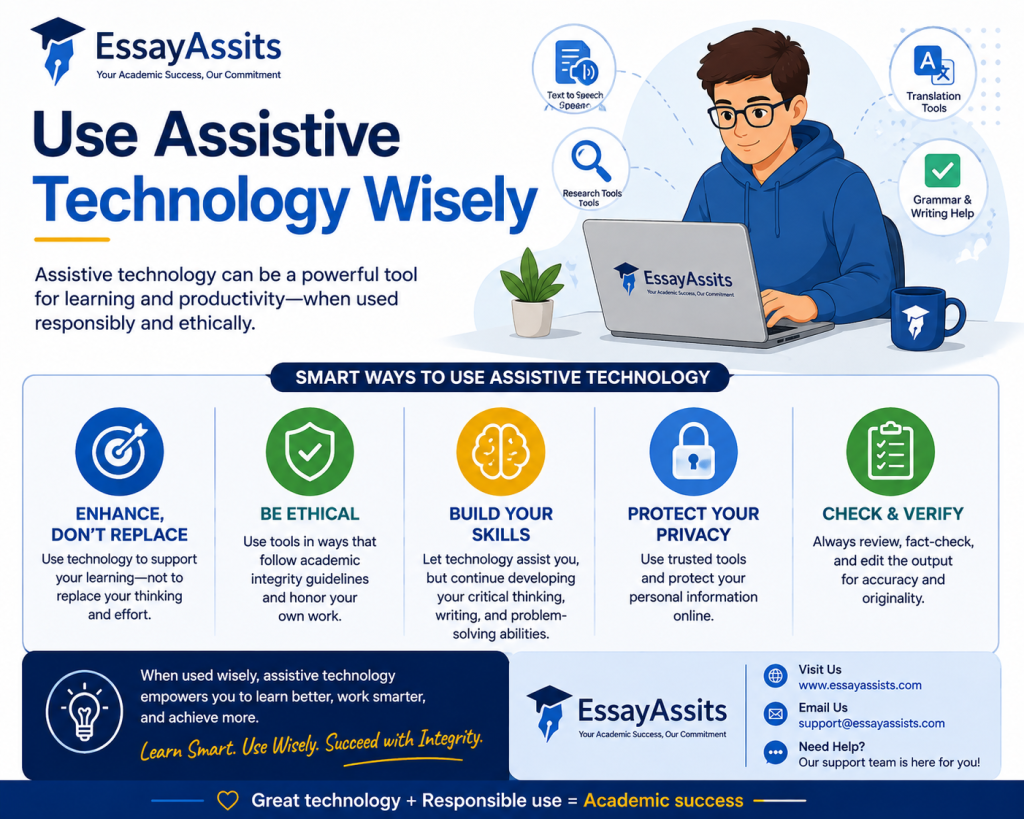
Modern technology can provide valuable support for students with dyslexia.
Useful tools may include: Spell checkers, Grammar checkers, Text-to-speech tools, Speech-to-text software, Word prediction software, Digital dictionaries, Mind-mapping applications, Audio note-taking tools. Technology should support your learning and help you communicate your own ideas more effectively. Different tools work differently for different learners, so it can be useful to experiment and find the tools that suit your needs.
9. Listen to Your Essay Using Text-to-Speech
Proofreading can be difficult when you have been looking at the same document for a long time.
Text-to-speech technology allows you to hear your essay. Listening can help you identify, Missing words, Awkward sentences, Repeated words, Poor paragraph flow, Grammar mistakes, Sentences that do not make sense. You can also read your essay aloud yourself. Hearing the words can provide a different perspective from simply reading them silently.
10. Proofread Using a Checklist
Instead of trying to find every mistake at once, check your essay in stages.
First Check: Content
- Did I answer the question?
- Are my arguments clear?
- Did I include enough evidence?
Second Check: Organization
- Does my introduction make sense?
- Does each paragraph focus on one main idea?
- Do my paragraphs flow logically?
Third Check: Language
- Are the sentences clear?
- Are important words spelled correctly?
- Did I use appropriate punctuation?
Fourth Check: Formatting
- Did I follow the required referencing style?
- Is the word count correct?
- Did I follow the required instructions?
Using a structured proofreading checklist can make editing more manageable.
11. Give Yourself Extra Time
Essay writing often takes longer than students expect. Researching, organizing, drafting, and proofreading should not be rushed.
Start your assignment as early as possible and create small deadlines.
For example:
Day 1: Understand the question and research
Day 2: Brainstorm and create an outline
Day 3: Write the introduction and first body paragraph
Day 4: Complete the remaining paragraphs
Day 5: Edit and proofread
Where appropriate, students may also have access to accommodations such as additional time or alternative ways to demonstrate their knowledge.
12. Ask for Feedback
A second pair of eyes can be extremely valuable.
You can ask:
- A teacher
- A tutor
- A classmate
- A campus writing center
- An academic support service
Ask them to focus on specific areas, such as:
- Is my argument clear?
- Does the essay answer the question?
- Are my paragraphs organized?
- Which sections need improvement?
Feedback should help you become a stronger and more independent writer.
13. Focus on Your Strengths
Dyslexia can make certain aspects of writing challenging, but it does not define your abilities.
Many students with dyslexia have strengths in areas such as:
- Creativity
- Problem-solving
- Verbal communication
- Big-picture thinking
- Visual thinking
Use these strengths when developing your essay ideas. Your goal is not to write exactly like someone else—it is to communicate your knowledge and ideas effectively.
How EssayAssits Can Help Students
At EssayAssits, we understand that every student has different academic strengths and challenges. Students may sometimes need additional guidance when organizing an essay, understanding academic requirements, improving a draft, or learning how to structure their ideas. EssayAssits can provide support and guidance with areas such as:
- Understanding essay structure
- Creating essay outlines
- Organizing research
- Improving clarity and readability
- Editing and proofreading
- Understanding citation and referencing requirements
- Developing stronger academic writing skills
The goal should always be to help students better understand the writing process and develop confidence in communicating their own ideas.
Final Thoughts
Writing essays with dyslexia can present challenges, but the right strategies can make a significant difference. Start early, break the assignment into smaller steps, use visual planning, take advantage of appropriate assistive technology, and edit your work systematically. Living and studying with dyslexia can create additional challenges, particularly when reading and writing are involved. However, dyslexia does not prevent you from producing high-quality academic work.
With proper planning, visual organization, effective writing strategies, and careful proofreading, students with dyslexia can develop strong essays that meet academic requirements. The process may sometimes require additional time and effort, but with practice and the right support, it is entirely possible to communicate your ideas clearly and confidently and produce excellent academic work. Remember: great writing is a process, not something that has to happen perfectly on the first attempt. With planning, practice, support, and the right tools, students with dyslexia can become more confident and effective writers.
Frequently Asked Questions
Can a person with dyslexia write a good essay?
Absolutely. Dyslexia can affect aspects of reading and writing, but it does not determine a person’s intelligence, creativity, knowledge, or ability to develop strong ideas.
What is the best way for a dyslexic student to start an essay?
Start by understanding the question, brainstorming ideas, and creating a simple outline or mind map before writing full paragraphs.
Is speech-to-text useful for dyslexic students?
It can be helpful for some students, particularly those who find it easier to express ideas verbally. The resulting text should still be reviewed and edited carefully.
Should students with dyslexia use spell checkers?
Yes, when permitted for the assignment. Spell checkers and other assistive tools can help students focus more on communicating their ideas while supporting the mechanics of writing.
EssayAssits can provide academic writing guidance, including support with structure, organization, editing, and understanding essay requirements, helping students build greater confidence in the writing process.