
Introduction: Why Thesis Statement Writing Matters
Whether you’re writing a short essay or a lengthy research paper, crafting a powerful thesis statement is a crucial skill for academic success. A thesis statement serves as the roadmap for your writing, guiding your arguments and informing your readers about the purpose and scope of your paper.
But here’s the catch: most students struggle with thesis statement writing. Either they make it too vague, too broad, or too complicated. In this guide, we’ll break down the process step-by-step and give you practical tools to create clear, concise, and compelling thesis statements that will make your writing stand out.
What is a Thesis Statement?
A thesis statement is a single sentence—usually placed at the end of your introduction—that summarizes the main point or claim of your essay or research paper. It makes a specific assertion about your topic and sets up the structure for your entire piece.
Example:
“Excessive use of social media among teenagers contributes to higher levels of anxiety and depression by disrupting sleep patterns and reducing real-life social interactions.”
This statement clearly identifies the topic (social media use among teenagers) and the claim (it causes anxiety and depression due to certain factors).
Step 1: Understand the Purpose of Your Assignment

Before you begin thesis statement writing, carefully read your assignment prompt. Different types of essays require different types of thesis statements.
Types of Essays and Thesis Goals:
- Argumentative Essay: Take a stance and support it with evidence
- Analytical Essay: Break down an issue into parts and evaluate it
- Expository Essay: Explain a concept or process
- Compare and Contrast Essay: Highlight similarities and differences
Your thesis should reflect the purpose of the essay. Misalignment here is one of the biggest mistakes students make.
Step 2: Choose a Manageable and Specific Topic
A good thesis statement starts with a strong, focused topic. Avoid topics that are too broad like “climate change” or “education.” Instead, narrow them down:
Too Broad: Climate change is bad.
Better: Climate change has led to severe droughts in East Africa, negatively impacting agricultural economies and food security.
Ask yourself:
- Can I find enough credible sources?
- Is the topic too general or too niche?
- Can I cover the topic within my word limit?
Step 3: Do Preliminary Research
Before drafting your thesis, do some initial research to understand the scope of your topic. Skim academic journals, books, and reliable online sources.
Look for:
- Patterns and themes
- Gaps in research
- Expert opinions
- Statistical data
This will help you form an informed opinion and craft a thesis that is both original and backed by evidence.
Step 4: Ask the Right Questions
Asking critical questions helps you refine your idea into a strong thesis:
- What is my main point?
- Why does it matter?
- Who is affected?
- What are the implications?
- What evidence can I provide?
Example Question:
Topic: Online education
Question: How does online learning affect student engagement and academic performance in high school?
Step 5: Write the First Draft of Your Thesis Statement

Now that you have your research and direction, it’s time to write the first draft of your thesis statement.
Formula for a Strong Thesis Statement:
Topic + Claim + Reasoning/Evidence
Example:
“Online education decreases student engagement and academic performance in high schools due to lack of face-to-face interaction and increased screen fatigue.”
This statement includes the topic, makes a claim, and previews the reasoning that will be elaborated upon in the paper.
Step 6: Evaluate and Revise
A first draft is rarely perfect. Review and revise your thesis statement using these questions:
- Is it specific?
- Is it debatable?
- Is it concise?
- Does it preview the structure of the paper?
- Does it reflect the type of paper you’re writing?
Weak Thesis:
“Pollution is bad.”
Improved Thesis:
“Air pollution in urban areas contributes to increased respiratory diseases among children due to vehicle emissions and industrial waste.”
Step 7: Position Your Thesis Correctly
Always place your thesis statement at the end of your introduction paragraph. It acts as a transition into the body of your paper and sets the reader’s expectations.
Structure of Introduction:
- Hook or attention-grabber
- Background information
- Thesis statement
Example:
“As cities grow more crowded, the number of vehicles on the road has surged. This increase, while a sign of economic development, has also resulted in severe air pollution. Air pollution in urban areas contributes to increased respiratory diseases among children due to vehicle emissions and industrial waste.”
Common Mistakes to Avoid in Thesis Statement Writing
- Too Vague: Avoid unclear language
- Weak: “Technology is useful.”
- Better: “Virtual reality technology enhances learning experiences in medical training by allowing students to perform realistic simulations.”
- Too Broad: Focus your claim
- Weak: “Education is important.”
- Better: “Inclusive education practices improve academic performance and social skills among students with learning disabilities.”
- Not Arguable: Avoid statements that everyone agrees with
- Weak: “Smoking is bad for health.”
- Better: “Raising cigarette taxes by 20% would significantly reduce smoking rates among teenagers by making it less affordable.”
Tools and Resources to Help You
Use these tools to assist in thesis statement writing:
- Hemingway Editor: For clarity and conciseness
- Grammarly: For grammar and tone suggestions
- Thesis Generator (EasyBib or Scribbr): For structure ideas
- Purdue OWL: For writing guidelines and academic examples
Examples of Strong Thesis Statements by Essay Type
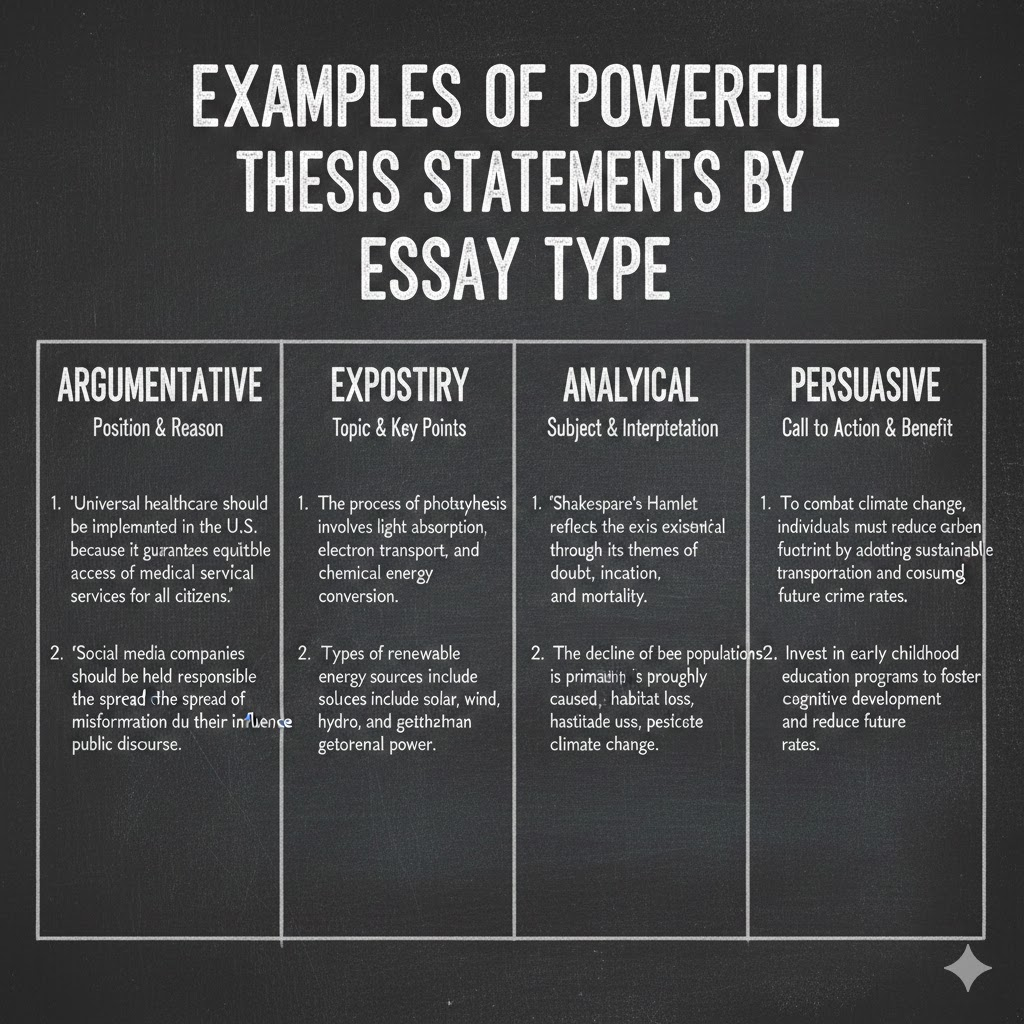
Argumentative Essay:
“The rise in telecommuting has led to a significant reduction in urban traffic congestion, proving remote work as a viable long-term solution for city planning.”
Analytical Essay:
“By examining Shakespeare’s use of soliloquies in Hamlet, we can better understand the protagonist’s internal conflict and the play’s exploration of existential themes.”
Expository Essay:
“Photosynthesis is the process by which green plants and some bacteria convert sunlight into energy, playing a crucial role in the Earth’s ecological balance.”
Compare and Contrast Essay:
“While traditional classrooms offer social engagement, online learning provides greater flexibility—each presenting unique advantages and challenges for modern students.”
Final Checklist Before You Submit
✅ Is my thesis specific and focused?
✅ Does it align with the purpose of my essay?
✅ Is it backed by research or logical reasoning?
✅ Have I positioned it correctly in the introduction?
✅ Is it original and not a cliché statement?
✅ Is it written clearly and concisely?
Conclusion: Mastering Thesis Statement Writing
A strong thesis statement is the foundation of a successful academic paper. It communicates your main idea clearly, guides the structure of your paper, and helps readers understand your argument. With practice and by following the steps outlined in this guide, you can master the art of thesis statement writing and significantly elevate your academic writing skills.
Need help crafting your next thesis? The experts at WriteMastersPro.com are ready to assist with professional academic writing support designed to help students succeed.
FAQs

1. What is a thesis statement?
A thesis statement is a single, clear sentence that expresses the main argument or focus of your essay. It tells readers what to expect and guides the direction of your writing.
2. Why is a thesis statement important?
A strong thesis helps organize your ideas, keeps your writing focused, and shows your reader the purpose of your paper. Without it, your essay may feel unfocused or unclear.
3. What makes a thesis statement “powerful”?
A powerful thesis is specific, arguable, and clear. It takes a stand, avoids vague language, and answers the question your assignment asks.
4. How long should a thesis statement be?
Most thesis statements are one to two sentences long. It should be concise but detailed enough to show your main point.
5. Where should the thesis statement be placed?
It typically appears at the end of the introduction paragraph to set up the argument for the rest of the paper.
6. What’s the difference between a strong and weak thesis statement?
A weak thesis is vague, too broad, or merely states a fact. A strong thesis is specific, focused, and provides a clear argument that can be supported with evidence.
7. Can a thesis statement be a question?
No. A thesis must provide an answer or argument—questions do not guide the reader or make a claim.
8. How do I write a thesis for different types of essays?
- Argumentative essays: Make a clear claim and support it with reasons.
- Analytical essays: Break down a subject and state what you will analyze.
- Expository essays: Present your main idea or explanation directly.
9. Can I revise my thesis statement later?
Yes. Many writers adjust their thesis as the paper develops. A thesis should evolve as your understanding deepens.
10. What are common mistakes to avoid?
Avoid vague words, overly broad claims, factual statements with no argument, and thesis statements that simply summarize the topic.
11. Do all academic papers need a thesis statement?
Most academic essays do, especially argumentative and analytical papers. Some creative or reflective assignments may not require one.
12. How can I check if my thesis statement is strong?
Ask yourself:
- Is it clear and specific?
- Does it take a stand?
- Can it be supported with evidence?
- Does it match the scope of my