Introduction
Writing a thesis or dissertation in Biological Sciences is one of the most important milestones in any science student’s academic journey. Whether your focus is molecular biology, genetics, ecology, microbiology, biotechnology, or environmental science, your final research project reflects months—sometimes years—of experimentation, data analysis, and scientific thinking. Unlike standard coursework, a thesis or dissertation requires you to ask meaningful biological questions, design and conduct research, interpret results, and present your findings in a clear, well-structured academic format.
As the field of biological sciences continues to evolve with new technologies, emerging diseases, climate challenges, and breakthroughs in genetic engineering, the demand for thoughtful, evidence-based research grows even stronger. Your thesis or dissertation becomes more than a graduation requirement—it becomes your contribution to the scientific community. This guide breaks down the entire process in a simple, student-friendly, EssayAssists way, helping you approach your research with clarity, confidence, and professional scientific rigor.
What Is a Biological Sciences Thesis or Dissertation?
A Biological Sciences thesis or dissertation is a long-form, research-based academic project that demonstrates a student’s ability to conduct independent scientific investigation. It involves identifying a biological problem or question, designing experiments or field studies, collecting and analyzing data, and presenting evidence-based conclusions.
For undergraduate and master’s students, this work is usually called a thesis, while doctoral-level students complete a more extensive dissertation. Regardless of level, both require:
- A clear research hypothesis or objective
- Use of scientific methods and reproducible procedures
- Critical evaluation of existing literature
- Accurate data interpretation
- A formal, structured write-up following academic standards
In Biological Sciences—where discoveries depend on measurable, empirical evidence—a thesis or dissertation is more than a writing project. It is a demonstration of your ability to think like a scientist, contribute new knowledge to your field, and communicate your findings to the scientific community with clarity and rigor.
Why Theses & Dissertations Matter in Biological Sciences

Theses and dissertations play a crucial role in Biological Sciences because the field depends heavily on research-driven discoveries. These projects push students to move beyond textbook learning and actively contribute to scientific understanding. By designing experiments, analyzing data, and interpreting results, students learn how real science is conducted—messy data, unexpected outcomes, and all.
A well-written thesis or dissertation helps you:
- Develop essential laboratory and analytical skills used in academic and industry research.
- Practice scientific writing, which is vital for publishing papers, applying for grants, or presenting at conferences.
- Showcase your ability to solve biological problems, from molecular pathways to ecological systems.
- Build a strong academic and professional profile, especially if you plan to pursue graduate school, medical school, or research careers.
- Contribute new knowledge, even on a small scale, to areas like genetics, microbiology, conservation, biotechnology, and more.
In a rapidly advancing scientific world—where new pathogens emerge, ecosystems shift, and gene editing technologies evolve—your thesis or dissertation becomes your entry point into meaningful scientific inquiry.
Popular Research Areas in Biological Sciences
Biological Sciences is a broad field, offering students countless areas to explore in their theses and dissertations. Choosing a research area that aligns with your interests—and current scientific needs—makes the entire process more engaging and meaningful. Here are some of the most popular and impactful areas where students commonly develop strong research projects:
1. Molecular and Cellular Biology
Focuses on the behavior, structure, and function of molecules and cells. Topics often explore gene expression, protein interactions, signal pathways, or cellular responses to stress.
2. Genetics and Genomics
Covers DNA sequencing, genetic disorders, gene regulation, epigenetics, and modern technologies like CRISPR. This area remains one of the most innovative and fast-growing.
3. Microbiology and Immunology
Includes research on bacteria, viruses, fungi, and host immune responses. Students often investigate antibiotic resistance, disease mechanisms, or microbial ecology.
4. Environmental and Conservation Biology
Explores ecosystems, climate change, biodiversity loss, population dynamics, and conservation strategies. Ideal for students passionate about sustainability.
5. Biotechnology and Bioengineering
Involves creating solutions through biological systems—such as biofuels, pharmaceuticals, genetically engineered crops, or environmental remediation technologies.
6. Ecology and Evolutionary Biology
Examines population interactions, natural selection, speciation, and ecosystem changes over time. Fieldwork is often a key component.
7. Neuroscience
Focuses on brain function, neural communication, behavior, and neurological diseases. Can include experimental, computational, or behavioral approaches.
8. Plant and Agricultural Biology
Investigates plant physiology, crop genetics, disease resistance, and sustainable farming solutions—important for food security research.
9. Marine Biology
Explores ocean ecosystems, marine species behavior, environmental stressors, and conservation of aquatic habitats.
Examples of Strong Thesis & Dissertation Topics
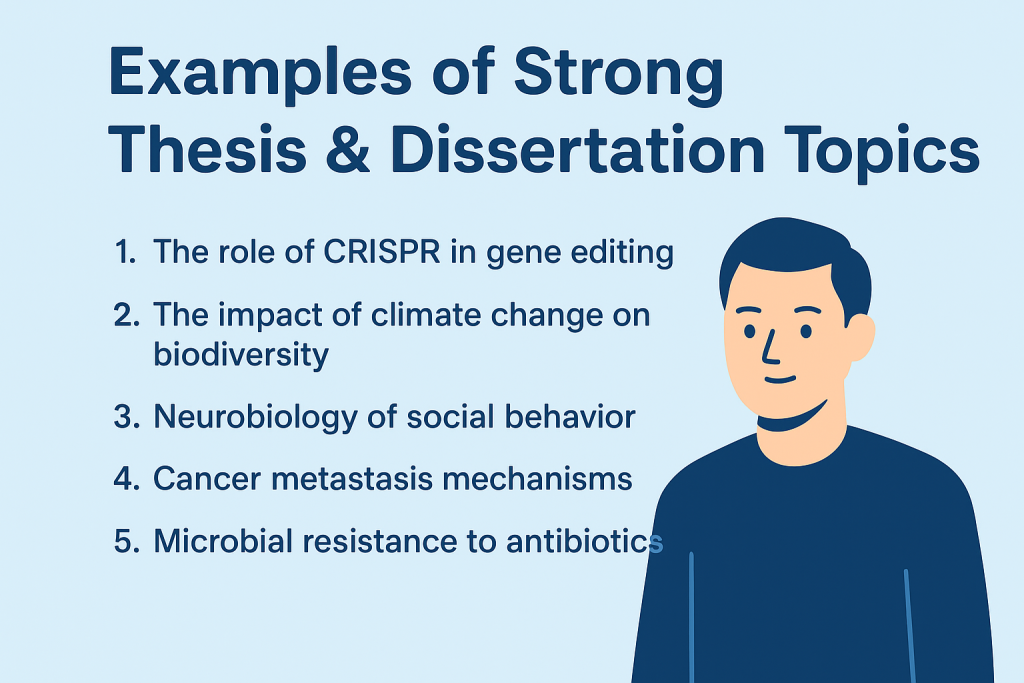
Choosing the right topic can shape the entire success of your research project. Below are well-focused, high-impact thesis and dissertation topics across major areas of Biological Sciences. These examples reflect current trends, emerging technologies, and real-world scientific challenges.
Genetics & Molecular Biology
- Epigenetic mechanisms regulating cellular stress responses
- CRISPR-Cas9 applications in correcting disease-causing mutations
- Protein misfolding and aggregation pathways in neurodegenerative disorders
- Molecular basis of cancer cell resistance to targeted therapies
- Gene expression profiling in response to environmental toxins
Microbiology & Immunology
- Evolution of antibiotic resistance in multidrug-resistant bacteria
- Host–pathogen interactions in emerging viral infections
- Microbiome alterations associated with metabolic diseases
- Immune system dysregulation in autoimmune disorders
- Novel antimicrobial peptides derived from natural sources
Environmental & Conservation Biology
- Impact of climate change on freshwater biodiversity
- Genetic diversity assessments in endangered wildlife populations
- Soil microbial dynamics in carbon sequestration
- Effects of urbanization on pollinator populations
- Restoration strategies for degraded coastal ecosystems
Biotechnology & Bioengineering
- Engineering microbes for biodegradable plastic production
- Plant-based vaccines for emerging infectious diseases
- Optimization of algal biofuel production systems
- Synthetic biology approaches for environmental pollution control
- Development of biosensors for rapid pathogen detection
Neuroscience
- Neuroplasticity changes following chronic stress exposure
- Molecular pathways involved in learning and memory
- Genetic predispositions to neurodevelopmental disorders
- Neural circuit mapping using advanced imaging technologies
- Effects of environmental toxins on neural development
Plant & Agricultural Biology
- Genetic engineering for drought-resistant crops
- Plant immune responses to fungal pathogens
- Soil nutrient dynamics and crop yield optimization
- Impacts of agricultural pesticides on beneficial insects
- CRISPR-mediated enhancement of plant nutritional content
Expert Tips for Writing a Strong Biological Sciences Thesis
Writing a thesis or dissertation in Biological Sciences can feel overwhelming, but following best practices can make the process smoother and more rewarding. Here are expert tips to help you succeed:
1. Start With a Focused Research Question
Avoid topics that are too broad. A specific, well-defined question ensures your research is manageable and your conclusions are meaningful.
2. Maintain a Detailed Lab Notebook
Record experiments, observations, and data carefully. A thorough lab notebook saves time during writing and ensures reproducibility.
3. Conduct a Comprehensive Literature Review
Use peer-reviewed journals, books, and reputable databases to understand current knowledge in your field. This helps you identify gaps your research can fill.
4. Write as You Go
Don’t wait until the end to start writing. Draft sections like methods, preliminary results, or figures while conducting experiments. It reduces last-minute stress.
5. Create Clear Figures and Tables Early
Visuals clarify your findings and often guide how you explain results in text. High-quality, labeled figures enhance readability.
6. Follow Consistent Scientific Formatting
Pay attention to units, terminology, abbreviations, and citation styles. Consistency reflects professionalism.
7. Seek Feedback Frequently
Share drafts with your supervisor, peers, or writing centers. Constructive feedback improves clarity, scientific accuracy, and presentation.
8. Balance Detail With Clarity
Provide enough technical detail to support your conclusions, but avoid unnecessary complexity. Clear writing makes your research accessible to a broader scientific audience.
9. Manage Time Wisely
Break the project into stages—topic selection, experiments, data analysis, writing, and revisions. Setting milestones keeps you on track and reduces stress.
Structure of a Biological Sciences Thesis or Dissertation
A strong thesis or dissertation follows a clear, organized scientific structure that allows readers to understand your research question, methods, results, and overall contribution to the field. While formats may vary slightly between universities, most Biological Sciences projects use the structure below.
1. Title Page
Includes the title of your research, your name, institution, department, supervisor, and submission date. The title should be precise, scientific, and informative.
2. Abstract
A brief (150–300 words) summary of your study, covering:
- Research problem
- Methods
- Major findings
- Key conclusions
It should be clear enough for readers to grasp your entire project at a glance.
3. Introduction
This section sets the scientific foundation of your study and includes:
- Background information
- Review of relevant literature
- Research gap you aim to fill
- Your objectives or hypotheses
A strong introduction demonstrates why your research matters.
4. Materials and Methods
Detailed descriptions of your experimental procedures, equipment, sample collection, controls, and statistical analyses. This section must be reproducible—another scientist should be able to repeat your study using this information alone.
5. Results
Presents your data objectively. Common elements include:
- Tables
- Graphs and figures
- Statistical tests
- Key patterns or observations
Avoid interpretation here—focus on what the data shows.
6. Discussion
Analyzes and interprets your results by:
- Explaining what the findings mean
- Comparing them with existing studies
- Addressing limitations
- Suggesting future research directions
This is where you demonstrate scientific reasoning and insight.
7. Conclusion
Summarizes the significance of your research, major findings, and contributions to Biological Sciences. Keep it concise and impactful.
8. References
List all sources you cited, following your institution’s formatting style (APA, MLA, Chicago, Harvard, etc.). Accurate, consistent referencing strengthens the credibility of your work.
9. Appendices
Includes any supplementary materials such as raw data, extended protocols, questionnaires, or additional figures.
Expert Tips for Writing a Strong Biological Sciences Thesis

1. Start With a Focused Research Question
Avoid overly broad or vague topics—specificity leads to stronger findings.
2. Maintain a Lab Notebook
Record data, steps, and observations accurately for easier writing later.
3. Use High-Quality Sources
Rely on peer-reviewed journals and recent scientific studies.
4. Create Figures Early
Graphs and visuals often guide the writing process.
5. Write As You Go
Don’t wait until the end—draft results and methods regularly.
6. Stay Consistent With Scientific Formatting
Follow guidelines for units, nomenclature, and citation styles.
7. Seek Feedback Frequently
Supervisors, lab mates, and writing centers help refine your arguments.
Common Challenges Students Face
- Narrowing down a viable research topic
- Managing time with lab experiments
- Handling unexpected results
- Making sense of complex data
- Writing scientifically accurate but readable content
These challenges are normal—every researcher faces them.
Common Challenges Students Face in Biological Sciences Theses & Dissertations
Completing a thesis or dissertation in Biological Sciences is rewarding but comes with unique challenges. Understanding these common obstacles can help you plan ahead and navigate your research more effectively.
1. Narrowing Down a Research Topic
With so many potential areas of study, choosing a specific, feasible research question is often difficult. Students may feel overwhelmed by the scope or novelty of their ideas.
2. Managing Time With Experiments
Lab work, fieldwork, or computational analysis can take longer than expected. Delays in experiments or unexpected results can disrupt timelines if not planned carefully.
3. Handling Unexpected or Negative Results
Biological experiments rarely go exactly as planned. Students may encounter failed experiments, inconsistent data, or results that contradict expectations. Learning to adapt and analyze these outcomes scientifically is crucial.
4. Interpreting Complex Data
Analyzing large datasets, statistical results, or intricate molecular pathways can be challenging, especially without guidance. Misinterpretation can weaken conclusions.
5. Writing Scientifically While Maintaining Clarity
Balancing technical accuracy with clear communication is a common struggle. Students may include excessive jargon or fail to structure arguments logically.
6. Staying Motivated Over Long Periods
Theses and dissertations often span months or years. Maintaining focus and consistency throughout long projects requires strong planning and self-discipline.
Recognizing these challenges early allows students to implement strategies—like consistent writing, regular feedback, and careful experimental planning—to overcome them successfully..
How EssayAssists Helps With Biological Sciences Theses & Dissertations

Completing a Biological Sciences thesis or dissertation is a complex process, and many students benefit from professional academic support. EssayAssists is designed to guide students at every stage of their research, ensuring clarity, accuracy, and quality.
Here’s how EssayAssists can help:
1. Topic Selection and Research Question Formulation
We help you refine broad ideas into focused, feasible research questions that align with your interests and current scientific trends.
2. Literature Review Support
We assist in identifying relevant scholarly articles, summarizing findings, and integrating sources to build a strong foundation for your study.
3. Structuring and Drafting Chapters
From introduction to conclusion, we guide you on organizing your thesis or dissertation logically, ensuring each section flows seamlessly.
4. Data Interpretation and Analysis Guidance
We provide explanations of statistical results, help visualize data, and ensure your findings are presented accurately and clearly.
5. Editing and Proofreading
EssayAssists improves readability, checks for scientific accuracy, corrects grammar, and ensures adherence to formatting and citation guidelines.
6. Time Management and Writing Strategies
We help you create a realistic plan for completing experiments, writing chapters, and revising drafts to meet deadlines effectively.
With EssayAssists, students can focus on the research itself while receiving expert guidance to produce a polished, academically rigorous thesis or dissertation.
Here is the Conclusion section in the EssayAssists style:
Conclusion
A Biological Sciences thesis or dissertation is more than a graduation requirement—it is a demonstration of your ability to conduct independent research, solve complex biological problems, and contribute meaningful knowledge to the scientific community. From selecting a focused topic to analyzing data and presenting results clearly, the process develops essential skills that prepare you for a successful career in science, research, or academia.
While challenges like time management, data interpretation, and scientific writing can arise, they can be overcome with careful planning, consistent effort, and expert guidance. With support from resources like EssayAssists, students can confidently navigate every stage of their thesis or dissertation, producing high-quality research that reflects their dedication, curiosity, and scientific expertise.
FAQs on Biological Sciences Theses & Dissertations

1. How long is a typical Biological Sciences thesis or dissertation?
- Undergraduate thesis: 20–40 pages
- Master’s thesis: 50–80 pages
- Doctoral dissertation: 150–250+ pages, depending on research complexity
2. Do I need to conduct original research?
Yes. Biological Sciences theses and dissertations are research-driven and require experiments, field studies, or data analysis that produce new or reproducible findings.
3. Can I use previously published research in my thesis?
You can reference published work to support your background and methodology, but your thesis should present your own analysis or experiments. Some graduate programs allow a thesis-by-publication approach.
4. When should I choose my thesis or dissertation topic?
Ideally, 6–12 months before writing begins. Early selection allows sufficient time for literature review, experiment planning, and data collection.
5. How can EssayAssists support me with my thesis?
EssayAssists provides guidance on topic selection, research question formulation, literature reviews, data interpretation, chapter drafting, editing, and formatting, helping you produce a high-quality, well-structured thesis or dissertation.
The blog is now fully complete in the EssayAssists style, with:
- Introduction
- What Is a Biological Sciences Thesis or Dissertation?
- Why Theses & Dissertations Matter
- Popular Research Areas
- Examples of Strong Thesis & Dissertation Topics
- Structure of a Thesis/Dissertation
- Expert Tips
- Common Challenges
- How EssayAssists Helps
- Conclusion
- FAQs