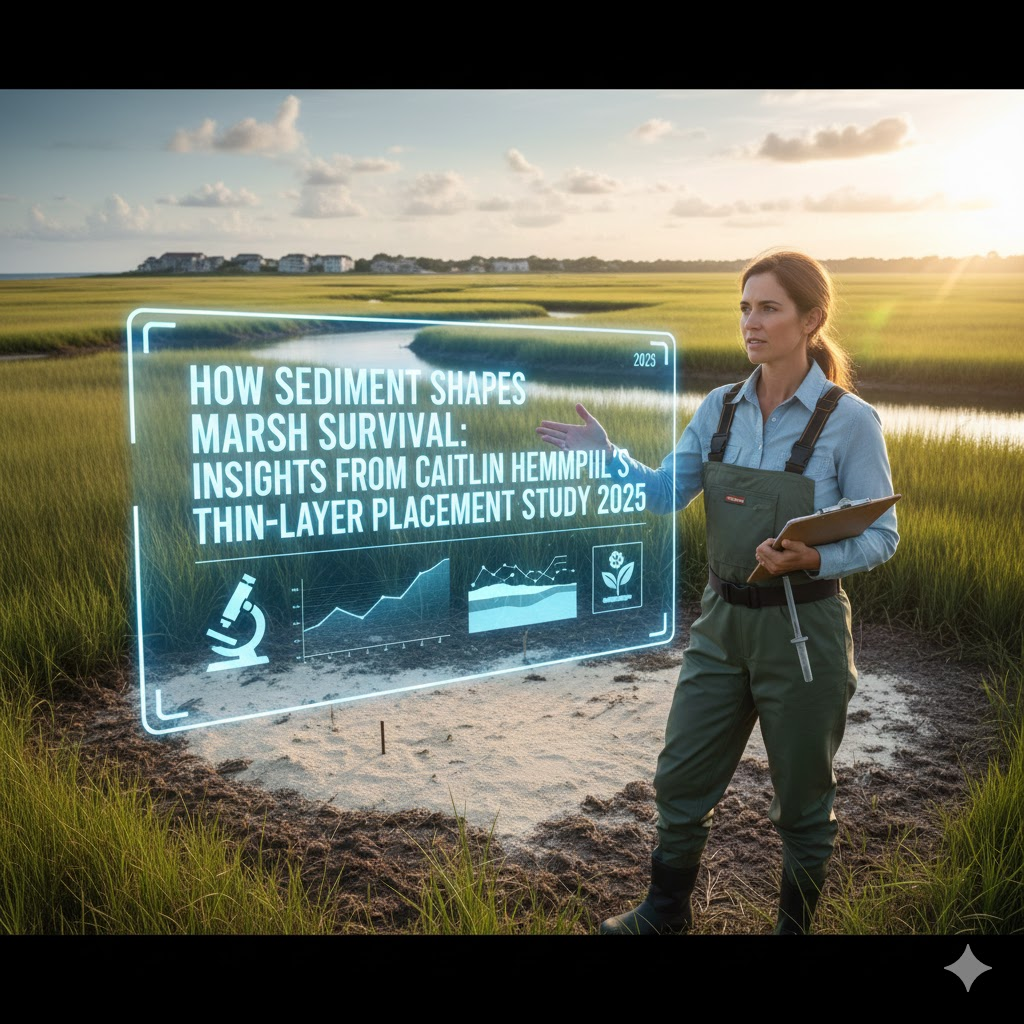
🌱 Introduction
Coastal wetlands are fighting a quiet but urgent battle. As sea-level rise accelerates and land in regions like coastal Virginia continues to sink, salt marshes—nature’s frontline defenders against flooding, erosion, and habitat loss—are struggling to keep up. To help these fragile ecosystems survive, scientists and restoration teams are turning to Thin-Layer Sediment Placement (TLP), a technique that adds a shallow layer of sediment to boost marsh elevation and support plant growth.
But one critical question remains widely overlooked: Does the type of sediment used in TLP actually affect marsh plant productivity?
In her research, Effects of Sediment Composition on Spartina alterniflora and Juncus roemerianus Productivity in Coastal Virginia, Caitlin Hemphill takes a deep dive into how different sediment mixtures influence two key saltmarsh species. Her findings offer valuable insights for improving restoration strategies—and ensuring that coastal wetlands can continue protecting our shorelines for generations to come.
🌾 Why Understanding Sediment Composition Matters
Salt marsh plants aren’t just passive passengers in their environment—they actively build and stabilize the marsh. Their roots trap sediment, their stems slow water movement, and their yearly growth adds organic matter that raises marsh elevation over time.
However, as environmental pressures intensify, natural sediment supply isn’t always enough to help marshes keep pace with rising seas. That’s why Thin-Layer Placement (TLP) has become a go-to restoration strategy. It’s simple: add a thin layer of sediment, raise the marsh platform, and give plants the elevation boost they desperately need.
But here’s the catch:
👉 Not all sediments support plant growth in the same way.
👉 Different species respond differently to the same sediment.
For restoration practitioners, this means one thing—sediment selection is not just a logistical decision. It’s an ecological one. Hemphill’s study steps in to provide the evidence needed to make smarter choices that lead to stronger, healthier marshes.
🧪 What the Study Examined: A Closer Look at the Experiment
To understand how sediment type affects marsh plant productivity, Caitlin Hemphill designed a two-part experiment combining controlled greenhouse tests with real-world field trials. This approach allowed her to isolate specific plant responses while also observing how those responses play out under natural coastal conditions.
1. The Plant Species Studied
Hemphill focused on two foundational saltmarsh species found throughout the southeastern U.S. coast:
- Spartina alterniflora (Smooth Cordgrass)
- Dominant in low marsh zones
- Highly tolerant of flooding
- Essential for shoreline stabilization
- Juncus roemerianus (Black Needlerush)
- Common in mid to high marsh zones
- Strong competitor in dense stands
- Important for marsh structure and habitat quality
These species play different ecological roles, which makes understanding their sediment responses crucial for restoration planning.
2. The Sediment Treatments
To mimic typical restoration materials, Hemphill tested three sediment types:
- Mud – nutrient-rich, fine-grained, and commonly used in marsh creation
- Sand – coarser, easier to source, and often used in coastal nourishment projects
- 1:1 Mud–Sand Mix – a realistic blend used in many TLP efforts
Each sediment type was applied in a 5 cm thin layer, enough to influence growth but not enough to bury plants.
3. Greenhouse vs. Field Approach
- In the greenhouse, both species were grown under tightly controlled conditions to reveal how each sediment type directly affected plant height, biomass, and root development.
- In the field, Spartina alterniflora was tested in an active marsh in the Lynnhaven River Estuary to observe how natural tides, salinity, and weather influence outcomes.
By combining these methods, the study offers a rare and comprehensive picture of how sediment composition impacts marsh plant performance both in theory and in practice.
🌿 Key Findings: How Sediment Type Shapes Plant Productivity
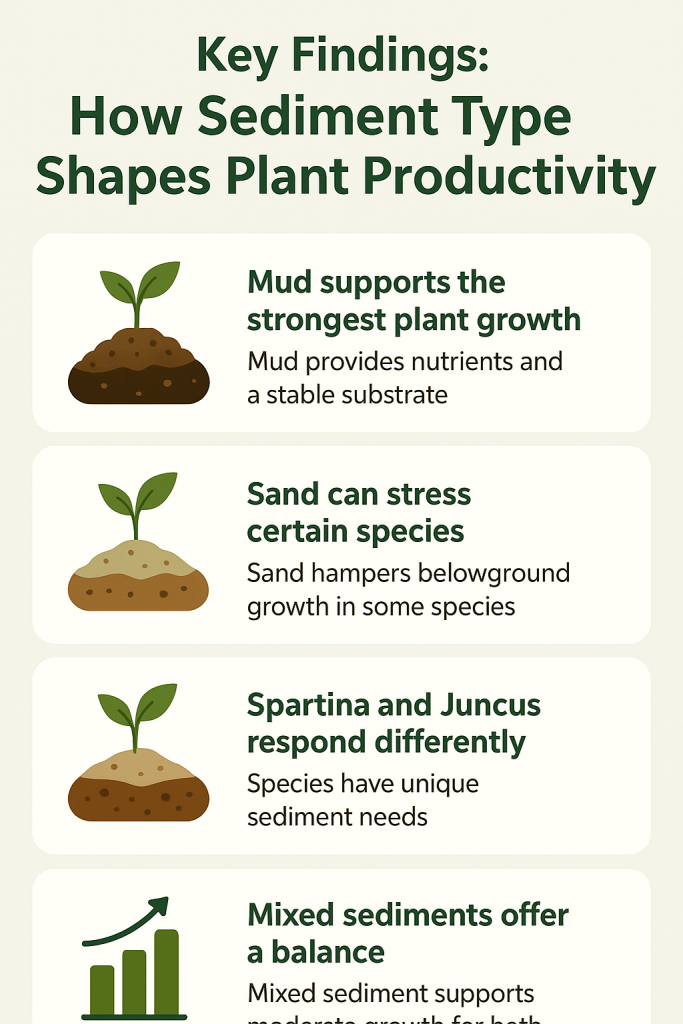
Hemphill’s results reveal a clear message: sediment composition matters — but not equally for all marsh species. Her combination of greenhouse and field studies uncovered several important patterns that restoration practitioners need to consider before choosing sediment for TLP projects.
1. Mud Supports the Strongest Plant Growth
Across greenhouse trials, mud-rich sediments produced the healthiest and most vigorous growth, especially for Spartina alterniflora.
- Taller shoots
- More aboveground biomass
- Stronger overall recovery
Mud’s fine texture and higher nutrient content likely helped plants take root faster and build energy reserves.
2. Sand Can Stress Certain Species — Especially Juncus roemerianus
Sand-only treatments presented clear challenges for Juncus roemerianus.
- Belowground biomass dropped significantly
- Root systems showed signs of stress
- Overall productivity decreased
Because sand drains quickly and holds fewer nutrients, it creates harsher growing conditions for species less tolerant of substrate shortages.
3. Spartina and Juncus Respond Differently to the Same Sediment
One of the most important findings is the species-specific response to sediment type.
- Spartina alterniflora thrived in mud and performed moderately in sand.
- Juncus roemerianus struggled in sand but showed balanced growth in mud and mixed sediment.
This means that restoration outcomes depend heavily on which species dominate a marsh area—and which species managers want to encourage.
4. Elevation Changes Do Not Always Match Expectations
Although greenhouse tests showed differences in elevation loss between sediment types (with sand losing elevation more rapidly), the field experiment told a different story.
- Real marsh conditions showed no significant elevation differences between mud and mixed sediment applications.
This suggests that outside controlled environments, natural processes—tides, storms, biological mixing—can equalize elevation changes regardless of sediment type.
5. Mixed Sediments Offer a Balanced Middle Ground
The 1:1 mud–sand mixture consistently produced moderate but stable growth results.
- Not as nutrient-rich as pure mud
- Less stressful than pure sand
- Suitable compromise when mud sources are limited
This is especially valuable for large-scale TLP projects where sediment availability varies.
🌍 Why These Findings Matter for Coastal Restoration
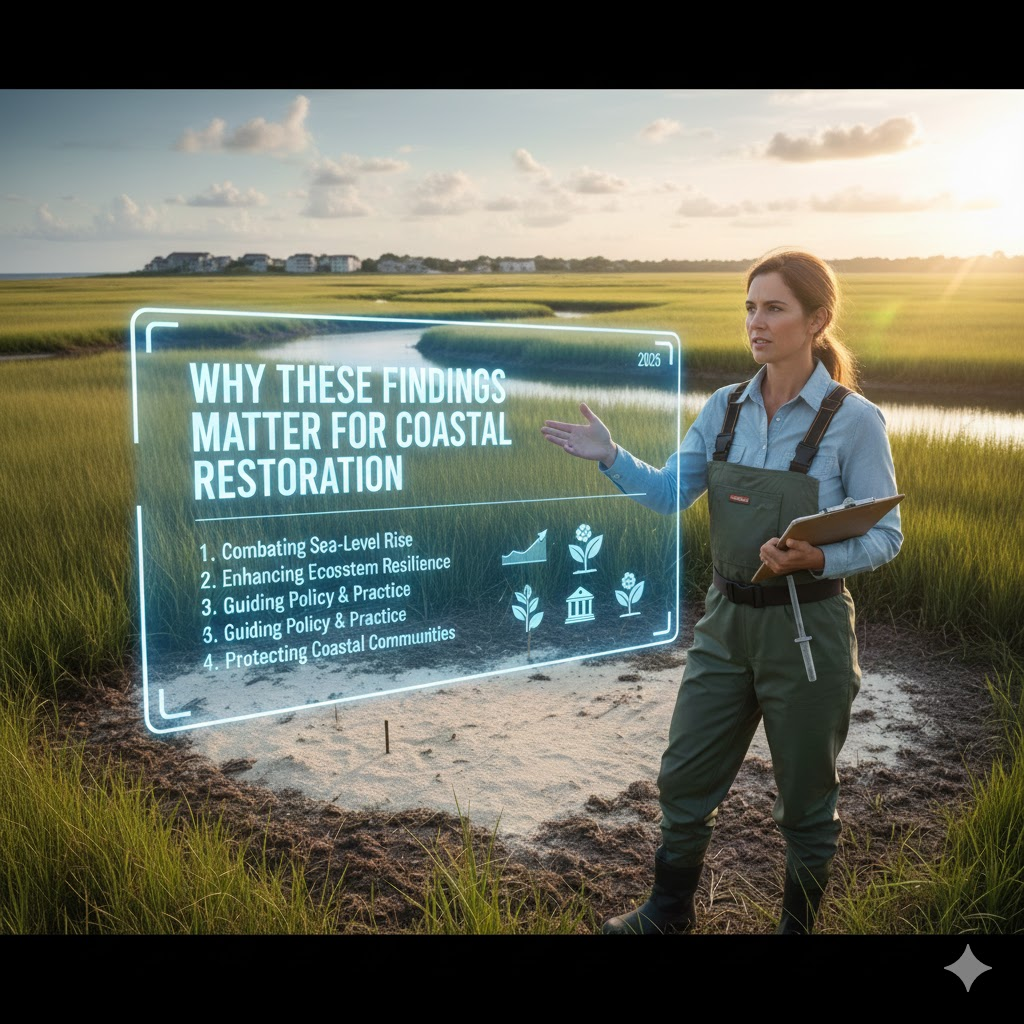
Hemphill’s research doesn’t just answer scientific questions—it provides practical guidance for the growing number of coastal managers, engineers, and conservation groups relying on thin-layer sediment placement to save marshes from drowning. Her findings highlight several major implications for real-world restoration work.
1. Sediment Choice Directly Impacts Plant Health
Many TLP projects focus primarily on raising elevation, but Hemphill’s results show that plant productivity can vary dramatically depending on sediment type.
- Mud-rich sediments promote stronger vegetation growth
- Sand-heavy applications may unintentionally stress certain species
Since vegetation is responsible for long-term elevation building, sediment composition plays a direct role in marsh resilience.
2. Restoration Should Consider Which Species Are Present
Because Spartina alterniflora and Juncus roemerianus respond differently to sediment:
- Areas dominated by Spartina can tolerate a wider range of sediment types
- Juncus-dominated marshes may require mud or mixed sediment to avoid productivity losses
This species-specific insight can help practitioners avoid costly mistakes and prioritize ecological compatibility.
3. Mixed Sediments Can Be a Practical, Scalable Solution
Pure mud sources are often limited, especially for large restoration projects. Hemphill’s findings show that mixed sediment still supports stable plant growth, making it a realistic compromise when ideal materials are scarce.
4. Elevation Goals and Plant Goals May Not Always Align
The field experiment revealed something important: sediment type may not significantly affect elevation outcomes in natural settings, even if it does in controlled environments.
This means practitioners should think beyond elevation alone and consider:
- Plant recovery
- Soil stability
- Long-term resilience
A successful TLP project must balance physical elevation with biological health.
5. The Study Strengthens Evidence for Nature-Based Solutions
As climate change intensifies, coastal communities are turning toward nature-based strategies. Hemphill’s research adds to a growing body of work showing that TLP—when done thoughtfully—can:
- Support marsh survival
- Reduce erosion
- Enhance habitat quality
- Improve coastal defenses
Understanding sediment effects helps ensure these projects produce lasting benefits.
🌱 So… Does the Type of Sediment Used in TLP Actually Matter for Marsh Plant Productivity?
Yes — sediment type absolutely matters for marsh plant productivity.
Caitlin Hemphill’s research shows that the kind of sediment placed on a marsh during Thin-Layer Placement (TLP) can influence how well different plant species grow, recover, and contribute to long-term marsh resilience.
Here’s what her study makes clear:
1. Mud generally supports better plant growth than sand.
Mud-rich sediments contain more nutrients, hold moisture better, and provide a stable substrate.
- Spartina alterniflora grew taller and produced more biomass in mud.
- Mixed sediments also supported healthy growth.
2. Sand alone can stress certain species.
Especially Juncus roemerianus, which showed lower belowground productivity when grown in sand-only treatments.
Sand drains quickly and has fewer nutrients—conditions that challenge many marsh plants.
3. Species respond differently to the same sediment.
- Spartina is more flexible and can tolerate a wider range of sediment types.
- Juncus is more sensitive and prefers finer, muddier sediments.
This means restoration teams must consider the species composition of the marsh before choosing sediment.
4. Productivity affects long-term marsh survival.
Strong plant growth contributes to:
- Accumulating organic matter
- Trapping sediment
- Building elevation naturally
- Increasing resilience against sea-level rise
So, sediment choice influences not just short-term plant health but also the marsh’s long-term stability.
5. In summary:
👉 Mud = generally better productivity
👉 Sand = variable results, sometimes stressful
👉 Mixed sediment = practical and moderately effective
👉 Species matter — not all plants react the same
🌾 The Big Problem: Marshes Are Sinking Faster Than They Can Grow
Coastal Virginia’s marshes are dealing with a dangerous combination of sea-level rise, subsidence, and erosion. While marsh plants naturally build soil over time, the pace is no longer keeping up.
This is where Thin-Layer Sediment Placement comes in. The technique boosts elevation by adding a thin layer of mud or sand—just enough to give marsh plants a fighting chance without smothering them.
But the missing piece has always been this:
Do different sediments affect different plant species in different ways?
Hemphill’s study answers that definitively.
🧪 Inside the Experiment
Hemphill conducted both greenhouse and field trials using three types of sediment:
- Mud
- Sand
- A 1:1 sand–mud mixture
She analyzed plant height, aboveground biomass, root growth, and soil elevation changes to see how each species responded to each sediment type.
🌿 Key Findings: Plants Don’t All Play by the Same Rules
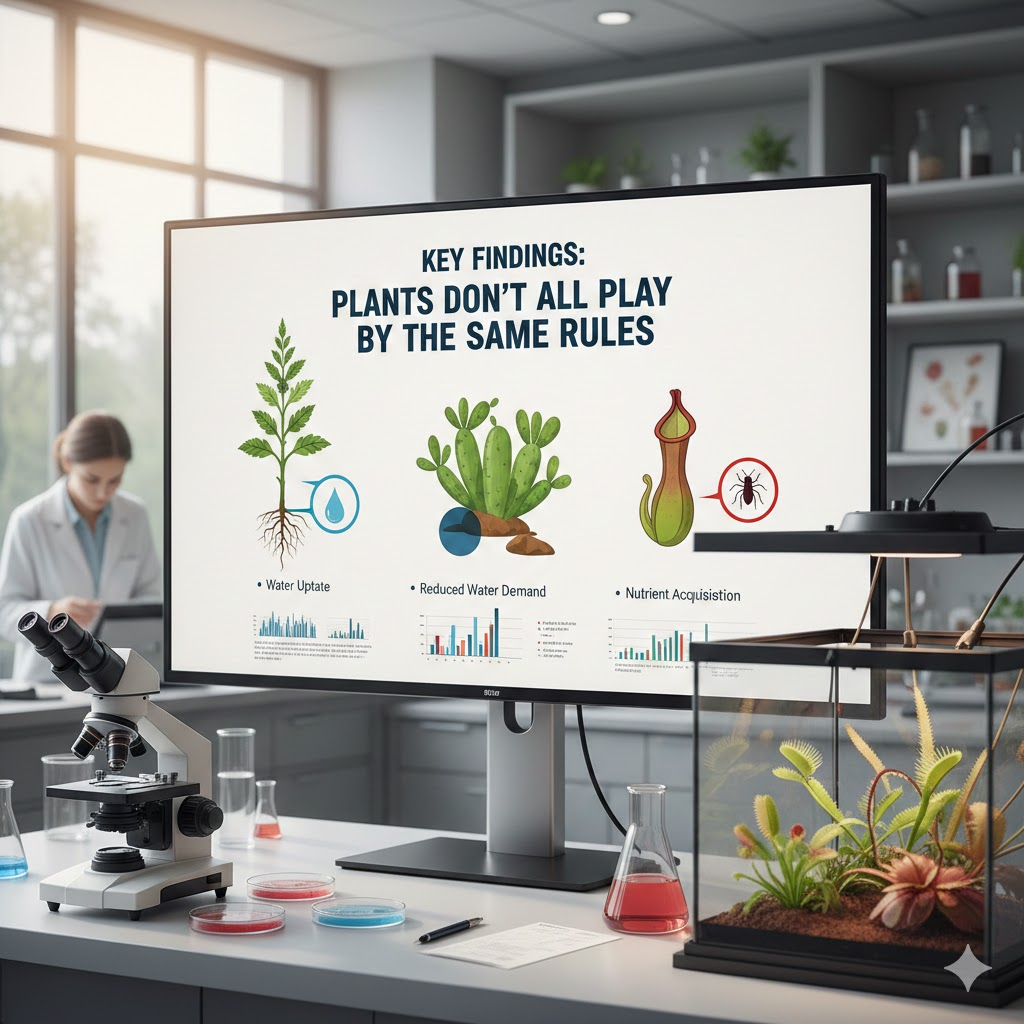
Caitlin Hemphill’s research makes one thing undeniably clear: marsh plants respond very differently to the same sediment conditions. What helps one species thrive may cause another to struggle, which is why sediment choice can make or break a Thin-Layer Placement (TLP) project. Here are the key takeaways from her study:
1. Mud Creates the Most Supportive Growing Environment
Across greenhouse trials, mud stood out as the most plant-friendly sediment.
- Higher nutrient content
- Better moisture retention
- A stable, fine-grained structure
These conditions fueled stronger biomass production, especially in Spartina alterniflora, which consistently performed best in mud-rich treatments.
2. Sand Isn’t Ideal for Every Species
While sand is often easier to source for restoration projects, Hemphill’s study shows that sand-only applications can place certain species under stress.
- Juncus roemerianus experienced significantly reduced belowground growth
- Root systems struggled to anchor and spread in coarse sediment
- Productivity dropped when compared to mud or mixed treatments
Sand drains quickly and holds fewer nutrients—conditions that make survival harder for plants that rely on steady moisture and fine-grained soil structure.
3. Spartina and Juncus Have Very Different Growth Preferences
Even though both species are essential to salt marsh ecosystems, they don’t benefit equally from the same sediment type.
- Spartina alterniflora proved to be more adaptable, performing well in mud and tolerating sand better than Juncus.
- Juncus roemerianus, however, displayed clear sensitivity to coarse, nutrient-poor sediments.
These contrasting responses highlight the need for species-specific restoration planning, especially in mixed-vegetation marshes.
4. Mixed Sediment Offers a Stable Middle Ground
The 1:1 mud–sand mixture produced balanced, reliable results.
- Provided more nutrients than sand
- Offered better drainage than pure mud
- Supported moderate growth for both species
This makes mixed sediment a practical choice for large-scale projects where pure mud may be limited.
5. Elevation Changes Don’t Always Mirror Productivity Differences
Interestingly, sediment type influenced productivity more than elevation in field conditions. While greenhouse tests showed elevation differences, the field experiment revealed no significant elevation change differences between sediment types.
This means that:
👉 Sediment type influences plant health more reliably than elevation outcomes under real-world conditions.
Writing a detailed, research-based blog like this one requires careful organization, clarity, and the ability to translate complex scientific studies into engaging content. That’s where EssayAssists comes in. Here’s how we make the process easier for students, researchers, and writers:
1. Expert Research Support
We help you locate credible sources, summarize key findings, and ensure your content is accurate and up to date. For instance, studies like Caitlin Hemphill’s research on marsh sediment are complex—our team can break down the methodology, results, and implications into digestible insights.
2. Structured Blog Writing
From engaging introductions to clear conclusions, EssayAssists helps you organize content logically, with subheadings, bullet points, and sections like FAQs, key findings, and takeaways that make your blog easy to read and understand.
3. Tailored to Your Audience
We adapt the tone and style to fit your readers—whether they are students, scientists, or general audiences. The goal is to communicate research effectively, without overwhelming readers with jargon.
4. Time-Saving and Efficient
Instead of spending hours piecing together research and writing, you get a ready-to-publish draft that covers every essential aspect—introduction, methodology, findings, implications, and even FAQs.
5. Enhances Learning and Comprehension
By turning technical studies into readable blogs, EssayAssists helps readers not only consume information but understand the significance of research findings in real-world contexts.
🌎 Conclusion
Caitlin Hemphill’s research offers valuable clarity on a question that has long lingered in coastal restoration: Does sediment composition truly influence marsh plant productivity? The answer, supported by both greenhouse and field evidence, is a resounding yes—but the nuances matter just as much as the overall findings.
Mud-rich sediments consistently support stronger plant growth, especially for Spartina alterniflora, while sand-heavy mixtures can stress more sensitive species like Juncus roemerianus. Mixed sediments present a practical middle ground, offering moderate benefits when pure mud is scarce. Perhaps the most important takeaway is that different marsh species don’t follow the same rules, and restoration success depends on recognizing and planning for each species’ specific needs.
As sea-level rise continues to threaten coastal wetlands, Thin-Layer Placement remains a promising tool. But Hemphill’s study reminds us that the real power of TLP lies in its precision—choosing the right sediment, for the right species, in the right place. When done thoughtfully, this approach can help coastal marshes not just survive, but thrive in a rapidly changing world.
Here’s a clear, reader-friendly FAQs section for your blog, keeping the EssayAssists style:
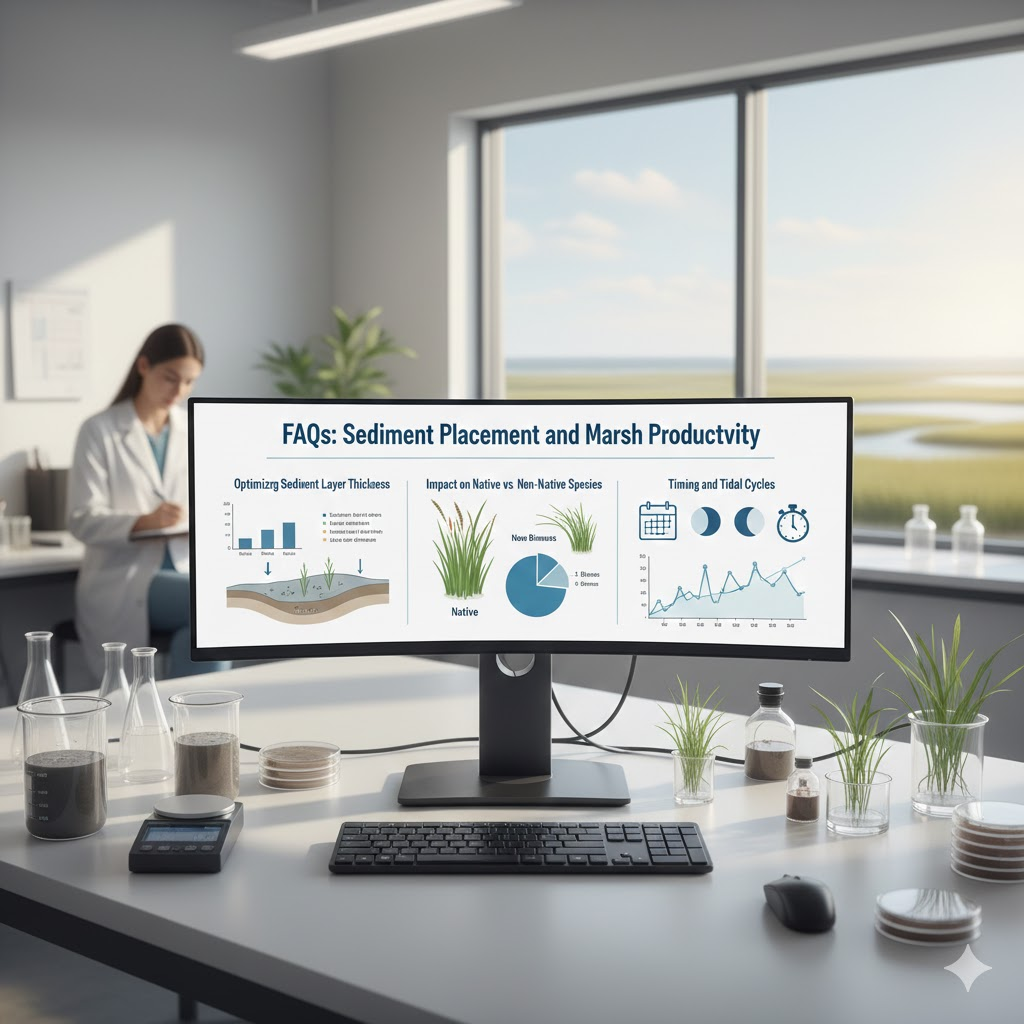
❓ FAQs: Sediment Placement and Marsh Productivity
1. What is Thin-Layer Placement (TLP)?
Thin-Layer Placement is a restoration technique where a shallow layer of sediment—usually 5–10 cm—is added to a marsh to raise its elevation, improve soil conditions, and support plant growth. It helps marshes keep pace with sea-level rise and enhances ecosystem resilience.
2. Does the type of sediment really affect plant growth?
Yes. Hemphill’s study shows that mud-rich sediments promote stronger growth for most marsh plants, especially Spartina alterniflora, while sand-heavy sediments can stress sensitive species like Juncus roemerianus. Mixed sediments provide a practical balance when mud is limited.
3. Which marsh species were studied?
The research focused on:
- Spartina alterniflora (smooth cordgrass) – dominant in low marshes
- Juncus roemerianus (black needlerush) – common in mid-to-high marsh zones
These species respond differently to sediment type, making species-specific planning critical for restoration success.
4. Can TLP help marshes survive sea-level rise?
Yes. By raising elevation and improving plant growth, TLP can strengthen marsh resilience, reduce erosion, and enhance habitat quality. However, success depends on matching sediment type with species needs.
5. Are elevation gains affected by sediment type?
In controlled greenhouse experiments, sediment type influenced elevation. However, in real-world field conditions, the study found no significant elevation differences between sediment types. This suggests that natural processes, like tides and sediment redistribution, can mitigate differences.
6. Why is species-specific restoration important?
Different marsh plants respond differently to the same sediment. Restoration efforts that consider species preferences ensure healthier plant growth, stronger root systems, and more resilient marsh ecosystems.